Products >> Railway Bogie >>
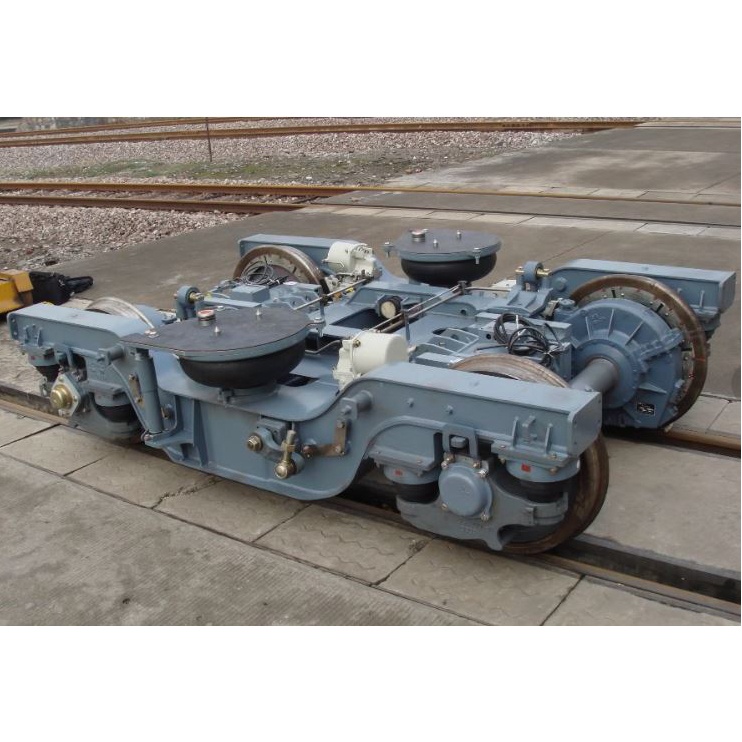
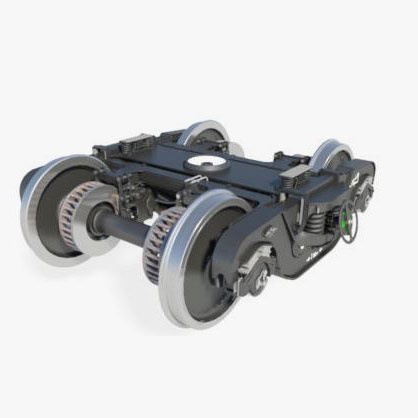
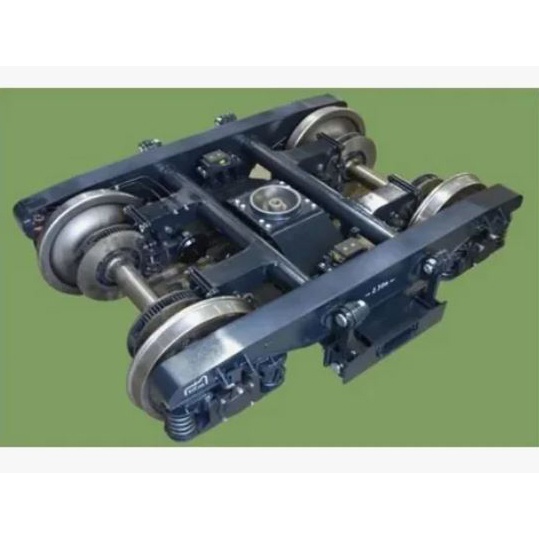
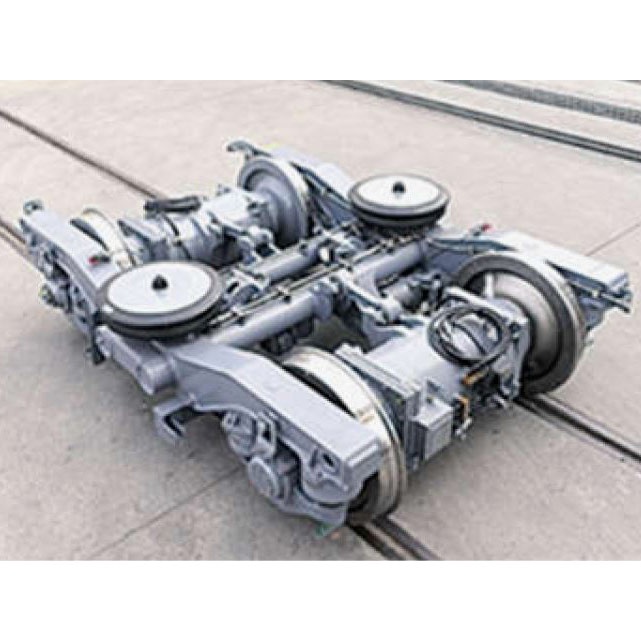
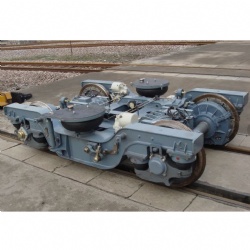
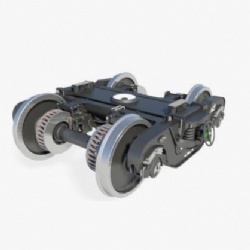
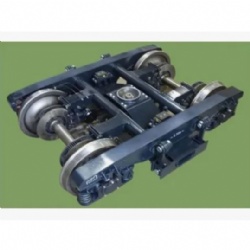
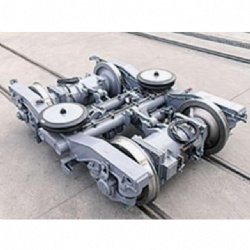
Passenger Car Welding Bogiefor urban transit
- Product No.:202681816127
- Price:nogotiation
- Material:high-quality carbon steel
- Standard:AAR or GB
- mould charge:Yes
- Production time:90
- weight:about 4000kgs
- Package:Pallent
Product Description
The High-Performance Passenger Car Bogie is an advanced rail vehicle suspension system engineered to deliver superior ride comfort, exceptional stability, and uncompromised safety for modern passenger rail applications. Designed for operating speeds up to 250 km/h, this bogie platform integrates optimized primary and secondary suspension parameters, advanced damping systems, and lightweight structural design to meet the demanding requirements of contemporary passenger transport.
This bogie system represents a comprehensive solution that balances critical performance indicators: running stability, passenger comfort, structural integrity, and maintenance efficiency. By combining proven engineering principles with state-of-the-art suspension technology, the bogie ensures smooth, quiet, and comfortable rides across diverse track conditions and operating speeds.
Design Philosophy & Engineering Excellence
The bogie design is grounded on the fundamental principle that suspension parameter optimization is the key determinant of vehicle dynamic performance. Extensive analytical studies demonstrate that the reasonable setting of primary longitudinal and lateral stiffness, combined with properly calibrated damping values, directly influences critical velocity thresholds, ride comfort indices, and overall vehicle stability.
Key engineering considerations include:
| Performance Factor | Design Approach |
|---|---|
| Hunting Stability | Optimized primary suspension stiffness and yaw damper settings increase critical velocity thresholds |
| Lateral Comfort | Reduced secondary lateral stiffness with appropriately increased lateral damping improves passenger comfort |
| Vertical Comfort | Balanced primary and secondary vertical damping values (not excessively high) prevent degradation of ride quality |
Structural Features
Frame System
-
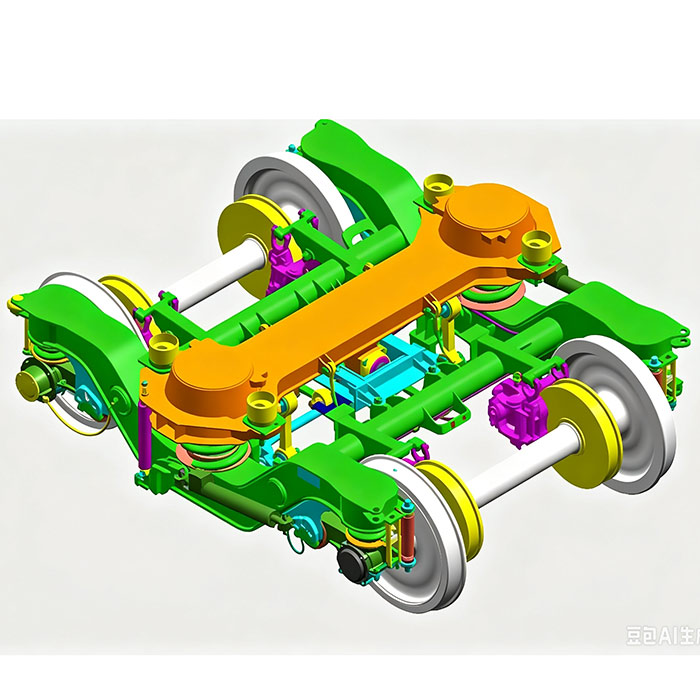
Construction: H-type welded steel plate frame with closed box section design
-
Side Sill: U-shaped cross-section with closed box construction, welded from upper and lower cover plates with internal ribs for reinforcement
-
Cross Beam: Seamless steel tube extending through the side sill for optimal load transmission
-
Weight Optimization: High strength-to-weight ratio achieved through structural design optimization
Primary Suspension System
-
Configuration: Axle-box positioning via rotating arm with rubber joint
-
Spring Element: Steel coil springs providing reliable primary suspension
-
Positioning: Rocker-arm type positioning with split-type elastic nodes in node holes
-
Vertical Damping: Calibrated vertical shock absorbers
Secondary Suspension System
-
Configuration: Bolsterless design featuring air springs and semi-active lateral damper
-
Air Spring System: Primary vertical suspension with optimized capsule diameter for enhanced comfort
-
Lateral Damping: Semi-active lateral damper providing adaptive damping characteristics
-
Hunting Damping: Anti-hunting damper for enhanced stability at high speeds
-
Additional Features: Rubber bump stop and traction rod assembly
Semi-Active Suspension System
The bogie incorporates semi-active lateral damper technology to overcome the limitations of passive suspensions at higher speeds. As train speeds increase, vibration problems become significantly more serious than at low speeds, and passive suspensions can no longer meet the demands of vehicle operation on different tracks at varying speeds.
System Components:
-
Semi-active damper unit
-
Controller
-
Acceleration sensors
Performance Benefits:
-
Superior ride indices compared to passive systems
-
Adaptive response to varying track conditions
-
Improved lateral comfort without compromising stability
-
Demonstrated through roller rig testing and theoretical validation
Dynamic Performance
| Parameter | Specification |
|---|---|
| Theoretical Nonlinear Critical Velocity | ≥ 480 km/h (validated through simulation) |
| Hunting Stability | Enhanced through optimized wheel-rail contact conicity control |
Ride Comfort
The bogie achieves lateral and vertical ride indices for the carbody below 2.5 (measured per international ride comfort standards).
Key Contributors to Comfort:
-
Reasonable setting of primary longitudinal and lateral stiffness
-
Appropriate secondary lateral damping values
-
Properly balanced vertical damping parameters
-
Optimized air spring characteristics
Technical Specifications
| Parameter | Specification |
|---|---|
| Design Speed | Up to 250 km/h |
| Axle Load | ≤ 14.5 tonnes |
| Bogie Mass | ≤ 6 tonnes (excluding wheelsets) |
| Track Gauge | Standard gauge (customizable) |
| Maximum Speed (Production Version) | 160 km/h (Model 68-4120); 200 km/h under development |
| Wheelbase | Per customer specification |
| Wheel Diameter | Standard passenger car wheels |
Applications
-
High-speed passenger trains (up to 250 km/h)
-
Intercity express services
-
Double-decker passenger cars (19.5-tonne axle load capability)
-
Electric and diesel multiple units
-
International rail export applications
Quality & Compliance
The bogie is designed and manufactured in accordance with international railway standards:
-
DIN EN 13749: Structural requirements for bogie frames (includes Amendment 2023)
-
European Standards: Compliance with EU Directive 2016/797/EU
-
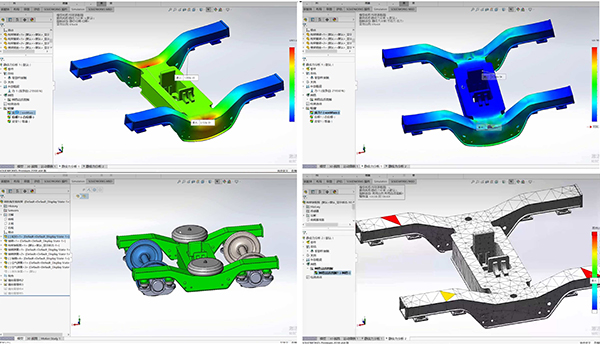
Strength Certification: Validated through finite element analysis and type testing
Testing & Validation:
-
Finite Element Analysis: Stress analysis using software (e.g., I-DEAS) to meet strength requirements for high-speed operation
-
Dynamic Simulation: Comprehensive multi-body dynamics analysis
-
Roller Rig Testing: Dynamic performance validation of prototype bogies
-
Type Testing: Mandatory qualification tests
-
Running Examination: Minimum 500,000 km safe operation validation
Technical Data Sheet
1. General Description
The High-Performance Passenger Car Bogie is a state-of-the-art bogie system designed for passenger rail applications requiring superior ride comfort and dynamic stability. The bogie features a welded H-type frame, optimized primary and secondary suspension systems, and semi-active lateral damping technology to deliver exceptional performance across a wide range of operating conditions.
2. Dimensional & Weight Data
| Parameter | Specification |
|---|---|
| Bogie Type | Bolsterless, H-frame |
| Wheelbase | Customizable per customer specification |
| Wheel Diameter | Standard passenger car wheel dimensions |
| Axle Load | ≤ 14.5 tonnes (standard); 19.5 tonnes (heavy-duty version) |
| Bogie Mass | ≤ 6 tonnes (without wheelsets) |
| Mounting Interface | Standard bolsterless car body interface |
3. Suspension System Specifications
Primary Suspension
| Component | Specification |
|---|---|
| Spring Type | Steel coil springs |
| Positioning | Rotating arm with rubber joint |
| Damping | Vertical shock absorbers |
| Longitudinal Stiffness | Optimized for high critical velocity |
| Lateral Stiffness | Calibrated for stability-comfort balance |
Secondary Suspension
| Component | Specification |
|---|---|
| Spring Type | Air springs with semi-active lateral damping |
| Lateral Damping | Semi-active lateral damper with controller and sensors |
| Hunting Damping | Anti-hunting damper |
| Additional Features | Rubber bump stop, traction rod assembly |
4. Material Specifications
| Component | Material | Treatment |
|---|---|---|
| Frame (Side Sills, Beams) | High-strength structural steel | Welded construction |
| Cross Beams | Seamless steel tube | — |
| Spring Elements | Alloy steel | Heat-treated |
| Rubber Joints | Engineering elastomer | Precision molded |
5. Performance Specifications
| Parameter | Requirement |
|---|---|
| Theoretical Critical Velocity | ≥ 480 km/h |
| Maximum Operating Speed | Up to 250 km/h |
| Ride Comfort Index | Lateral & vertical ≤ 2.5 |
| Hunting Stability | Suppressed through optimized wheel-rail contact parameters |
| Track Curve Negotiation | Enhanced through optimized torsion stabilizer design |
6. Applicable Standards
| Standard | Scope |
|---|---|
| DIN EN 13749 (2024) | Structural requirements of bogie frames |
| EU Directive 2016/797/EU | Interoperability of rail system |
| TB/T 1335-1996 | Chinese strength design standard for railway vehicles |
| 95101-M | Chinese strength certification standard |
7. Ordering Information
When placing inquiries, please specify:
| Item | Requirement |
|---|---|
| Design Speed | Up to 250 km/h standard |
| Axle Load | ≤ 14.5t standard; heavy-duty options available |
| Track Gauge | Standard or custom |
| Operating Environment | Temperature range, climate conditions |
| Customer-Specific Interfaces | Car body interface, brake system, traction system |
Related Products
Price: nogotiation
Price: nogotiation
Price: nogotiation
Price: nogotiation
Price: nogotiation
Price: nogotiation
Products Category
Contact Us
Name: Meiya
Tel: +86 15151598778
E-mail: meiya@guarail.com
WeChat: +86 15151598778
Whatsapp: +86 15151598778
Add: B1608 room Building 5 of Tainhe Huayuan ,YangJian Twon,Suzhou city ,Jiangsu ,China

 WhatsApp
 Mail inquiry